





Introducing Map of Peers: the tool for tracking nodes across Cosmos networks
When analyzing a blockchain network, much of the attention usually goes to validators or stake distribution. But there is another equally important layer for understanding how it really works: how nodes connect to each other.
The geographic distribution of peers, their proximity, and the diversity of their connections directly influence latency, block propagation, and the overall resilience of the network. And yet, this networking layer is not always easy to visualize or interpret.
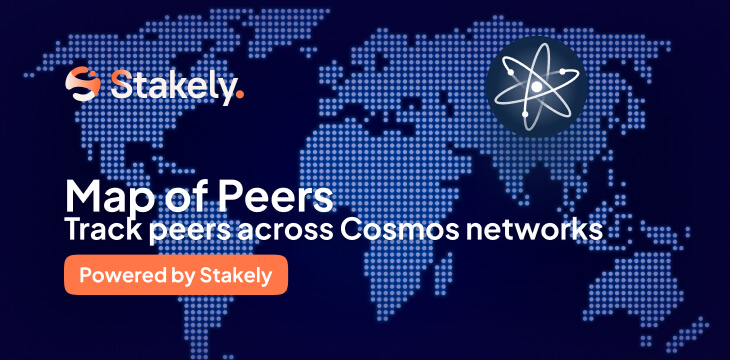
With that need in mind, at Stakely we developed Map of Peers, a tool to track, visualize, and analyze peers across Cosmos ecosystem networks in a much more practical way.
What is Map of Peers
Map of Peers is a tool that allows users to explore the peer network of different chains in the Cosmos ecosystem through a visual and interactive interface.
Beyond simply showing nodes on a map, its goal is to provide useful context for day-to-day operations: where peers are concentrated, how they are distributed globally, what signals can be observed regarding connectivity, and which nodes may be relevant from an operational perspective.
Currently, the tool already allows users to explore different Cosmos networks, such as Celestia, Cosmos Hub, Osmosis, Secret, Terra, Terra Classic, Shentu, and Story, with the possibility of expanding support to more networks in the future.
What problem does it solve
When it comes to operating nodes, reviewing connections, or understanding how a network is actually distributed, a list of IP addresses provides very little context on its own.
Map of Peers turns that P2P layer into a more visual and interpretable view, helping identify geographic distribution patterns, peer concentration, and useful signals for analyzing the operational state of a network.
It does not aim to summarize the full complexity of networking in Cosmos on its own, but rather to offer a clearer way to observe a layer that is often fragmented or not easily accessible.
How Map of Peers works
Map of Peers brings together several relevant elements for analyzing the peer network in a single interface, including:
- number of peers found,
- decentralization metrics,
- country and city with the highest peer density,
- interactive map,
- latency,
- generation of persistent peers configurations.
The flow is simple: you access the tool, select the network you want to analyze, and explore how its peers are distributed globally.
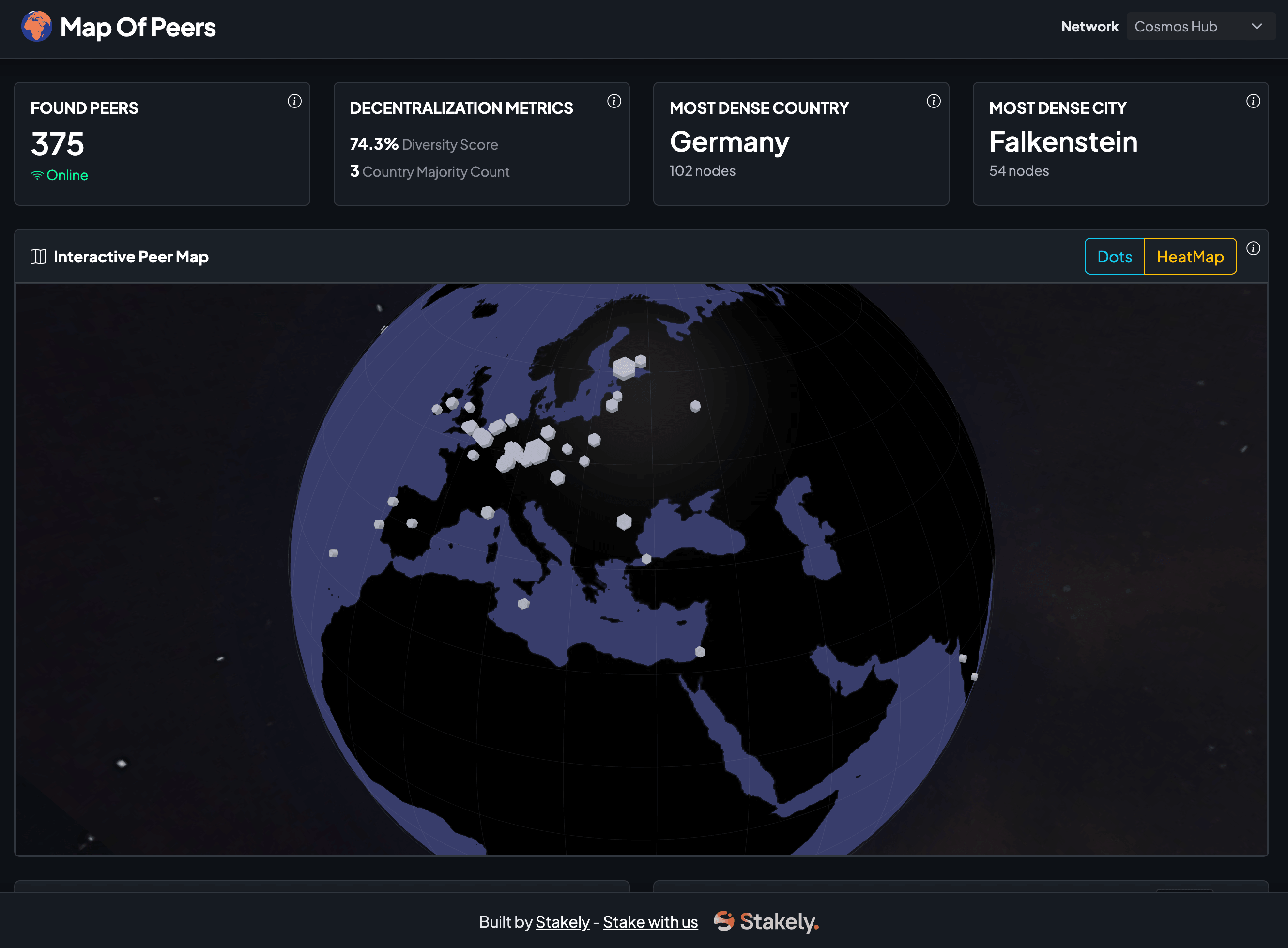
What metrics Map of Peers analyzes
1. Interactive map and geographic concentration It shows an interactive map with the peers detected on each network and metrics such as Most Dense Country and Most Dense City. It helps quickly identify where activity is concentrated and detect potential operational risks caused by geographic concentration.
2. Decentralization metrics The Decentralization Metrics section provides two signals about the geographic distribution of peers. The Diversity Score measures how balanced that distribution is across locations, while Majority Count indicates how many countries account for more than 50% of peers. These are not a complete measure of network decentralization, but they do help assess geographic dispersion and possible concentration risks.
3. Latency check With Check Latency, the tool allows users to select peers on the map and generate a terminal-ready command. This makes it easier to check latency against those nodes and make decisions based on more concrete data.
4. Persistent peers generation It allows users to generate persistent peers configuration. In CometBFT, these are peers that the node will automatically try to reconnect to if the connection fails, which is useful for validators, full nodes, and infrastructure teams.
Why analyzing peers matters in a Cosmos network
In networks built with the Cosmos SDK, the consensus and networking layer is managed by CometBFT. That means the peer-to-peer network is not a secondary detail, but a fundamental part of how blocks, transactions, and messages propagate between nodes.
That is why observing how peers are distributed provides valuable signals. It does not fully define the decentralization of a blockchain on its own, but it does help better understand its operational decentralization. By showing whether there is concentration in certain areas, whether connectivity appears balanced, or whether the network depends too heavily on certain geographic points.
A tool born from real needs
At Stakely, we continue building tools that respond to real operational and infrastructure needs. Map of Peers was born precisely from that idea: to offer a clearer way to observe and analyze the P2P layer in Cosmos networks.