






GenLayer launches Bradbury, its new testnet for testing AI within blockchain consensus
GenLayer has introduced Bradbury, its new testnet and the next step on its path toward mainnet. Bradbury focuses on the technical side, aiming to coordinate blockchain consensus with AI models and non-deterministic inference within a decentralized network.
Bradbury is not designed as just another infrastructure testnet. According to GenLayer, this phase aims to serve as an experimental environment where validators, builders, partners, and researchers can test how the network behaves when models, external data, and non-deterministic decisions come into play.
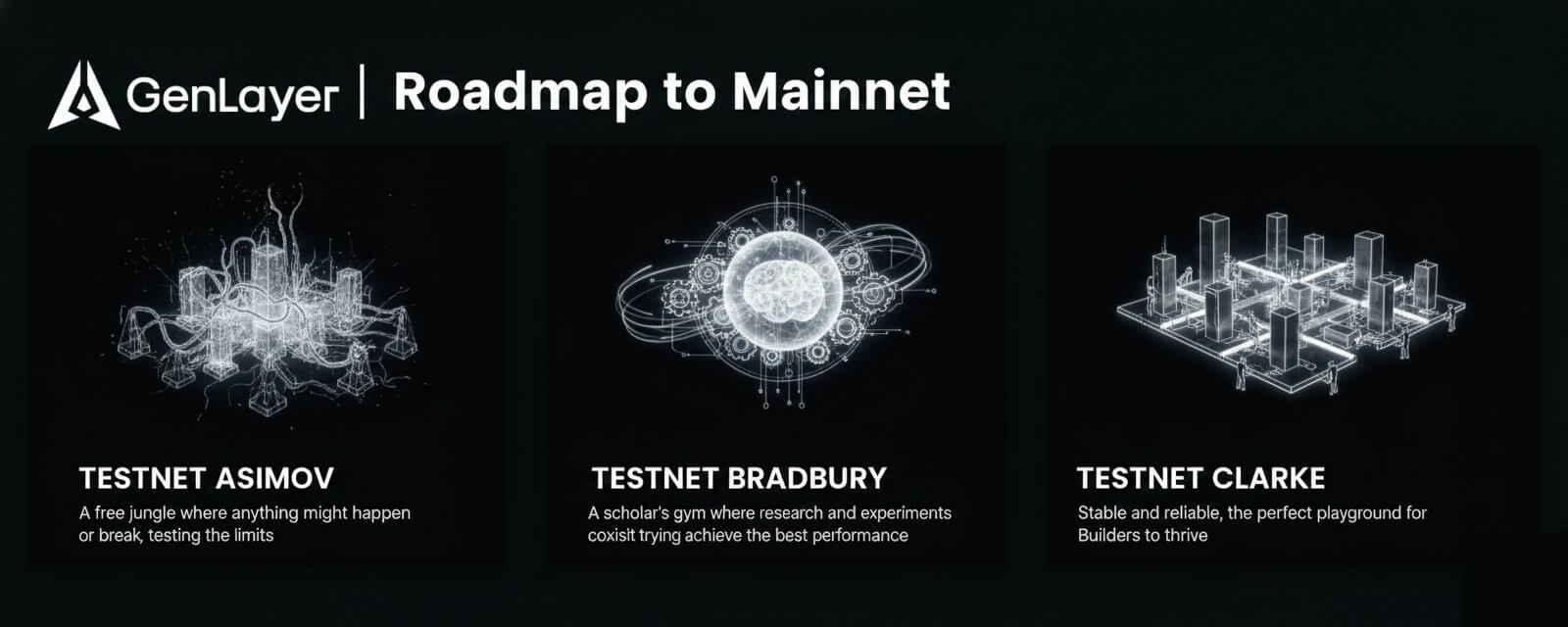
From Asimov to Bradbury: how GenLayer’s roadmap evolves
During Asimov, GenLayer focused on laying the foundations of the network and connecting the different components of the system. Bradbury shifts that focus: it introduces LLM inference and opens a more active phase of testing and optimization.

GenLayer itself describes Bradbury as an environment where participation becomes more active for everyone. It also highlights that, unlike Asimov, model selection and configuration are no longer secondary aspects but take a central role.

What GenLayer proposes and why Bradbury fits its vision
Bradbury naturally fits within GenLayer’s vision because it tests exactly the type of infrastructure this network aims to make viable: the execution of Intelligent Contracts in an environment where not everything is strictly deterministic.
When a contract uses language models or incorporates external data, the challenge is no longer just executing code, but ensuring that the network can validate results that are not always identical. This is where GenLayer’s architecture comes into play.
On one hand, Optimistic Democracy defines how executions are validated: a validator proposes a result and the rest review it. On the other hand, the Equivalence Principle allows different outputs to be accepted as long as they are equivalent according to the protocol’s criteria.
In this context, Bradbury stands out not just as a performance test, but as a space to explore how GenLayer behaves when bringing to consensus a type of computation that inherently introduces variability.
What Bradbury tests in practice
Bradbury is the environment where GenLayer aims to measure how this architecture behaves when real inference is involved. Moving from a passive network to a much more experimental one, validators and builders can deploy contracts and compare their execution on testnet versus Studio, with the goal of helping refine the system.
In this testnet, the questions Bradbury raises are quite specific:
- which model should be used for each contract,
- how to reduce costs without degrading results,
- how to strengthen security against prompt-based attacks,
- how to measure the impact of different configurations,
- and which economic incentives can help make validation sustainable.
Bradbury architecture: research and experimentation areas
This testnet opens up a real experimental space around inference, security, incentives, and consensus behavior. These are its key areas of experimentation:
1. Greyboxing
GenLayer defines greyboxing as the ability of validators to apply arbitrary transformations before each LLM call. This means that input and context can be captured, analyzed, modified, and filtered before triggering inference. This layer can improve performance, cost, and security at the same time.
Additionally, GenLayer links this logic to its future Constitution, a governance framework to agree on which transactions should be allowed or blocked. In that scenario, greyboxing would not only optimize model calls but also detect potential violations before processing.
2. Model routing
GenLayer proposes that validators do not rely on a single model for all contracts, but instead can choose different LLMs depending on the use case. This introduces a new operational and economic dimension to validation.
If a contract is executed thousands of times per day, it may be more efficient to use a smaller, cheaper, or specialized model. On the other hand, in appeals with higher economic risk, it may make sense to use a more powerful model to increase the likelihood of aligning with the majority.
3. Security in GenLayer
Bradbury also focuses on one of the best-known risks of LLM-based systems: prompt injection. GenLayer argues that the Optimistic Democracy consensus already provides an initial layer of protection, although it does not consider it sufficient on its own.
That is why it proposes that each node can inspect prompts and inputs before calling the model and apply local filters. Here, greyboxing once again stands out as an active defense mechanism, not just an optimization layer.
4. Benchmarks, gas, and model diversity
With Bradbury, GenLayer is not just presenting ideas, but aims to measure them through benchmarks, using Intelligent Contracts, datasets, and real application traffic to evaluate configurations, observe deviations, and compare results. This experimental environment is called Bradbury Gym.
This aspect connects directly with the protocol’s economics. GenLayer aims to adjust its reward and penalty system based on real testnet usage. As an example, GenLayer proposes a specific hypothesis: paying between 60 and 100 times the inference cost per transaction as gas to validators, so that it is not profitable to simply accept the leader’s response without properly validating it.
Alongside this, Bradbury will be used to study model diversity. According to GenLayer, Optimistic Democracy benefits from less correlated configurations among validators, whether through different LLMs, varying parameters, or alternative checkpoints. The idea is that lower correlation helps consensus converge more effectively toward correct answers.
This is one of the most valuable aspects of Bradbury from an infrastructure perspective. It is not just about running nodes, but about understanding how incentives, costs, inference quality, and technical diversity interact within a network that aims to operate with AI-native logic.
What Bradbury means for validators and developers
For developers, Bradbury provides a space to test contracts on a network with real consensus and compare their behavior against a local development environment. This allows analysis of latency, cost, routing, and the impact of inference under conditions closer to a live network.
For validators, the value lies in experimenting with a stack where optimization no longer depends solely on hardware or node maintenance. In GenLayer, it also involves model selection, pipeline configuration, security risk management, and the economic efficiency of each inference decision.
How to participate in the GenLayer Bradbury testnet
For those who want to actively participate in GenLayer and try Bradbury, it is already possible to do so through the contribution portal.
From there, users can access different ways to get involved in the testnet, both at a technical and community level.
Additionally, if you want to stay up to date without missing the most relevant developments, at Stakely we share weekly reports on Telegram covering the main updates in the GenLayer ecosystem, including testnet changes, technical insights, and protocol evolution.