





Staking Widget: integrate non-custodial staking directly into your product
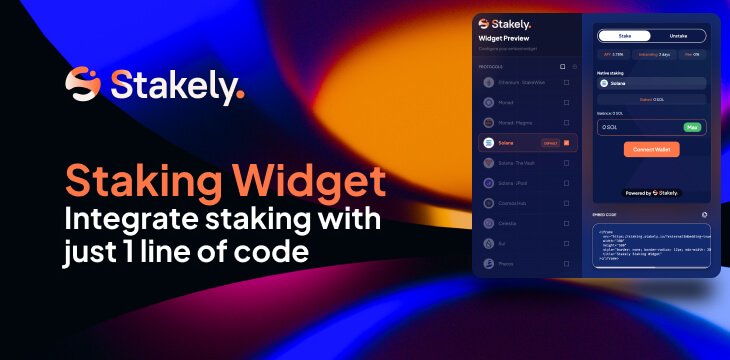
The Stakely Staking Widget lets teams create and manage an integrated staking experience inside a platform, without building the interface, staking logic and transaction flows for each network from scratch.
Integrating staking often requires front-end resources, protocol-specific knowledge and an operational layer able to keep up with every supported network. The widget simplifies that process so wallets, custodians, applications, platforms or any product working with digital assets can offer staking from their own environment.
The proposition is clear: a non-custodial, customizable and ready-to-use experience powered by Stakely's staking infrastructure. This allows the partner to add a new layer of value around staking, reduce development time and keep control of the experience inside their own product.
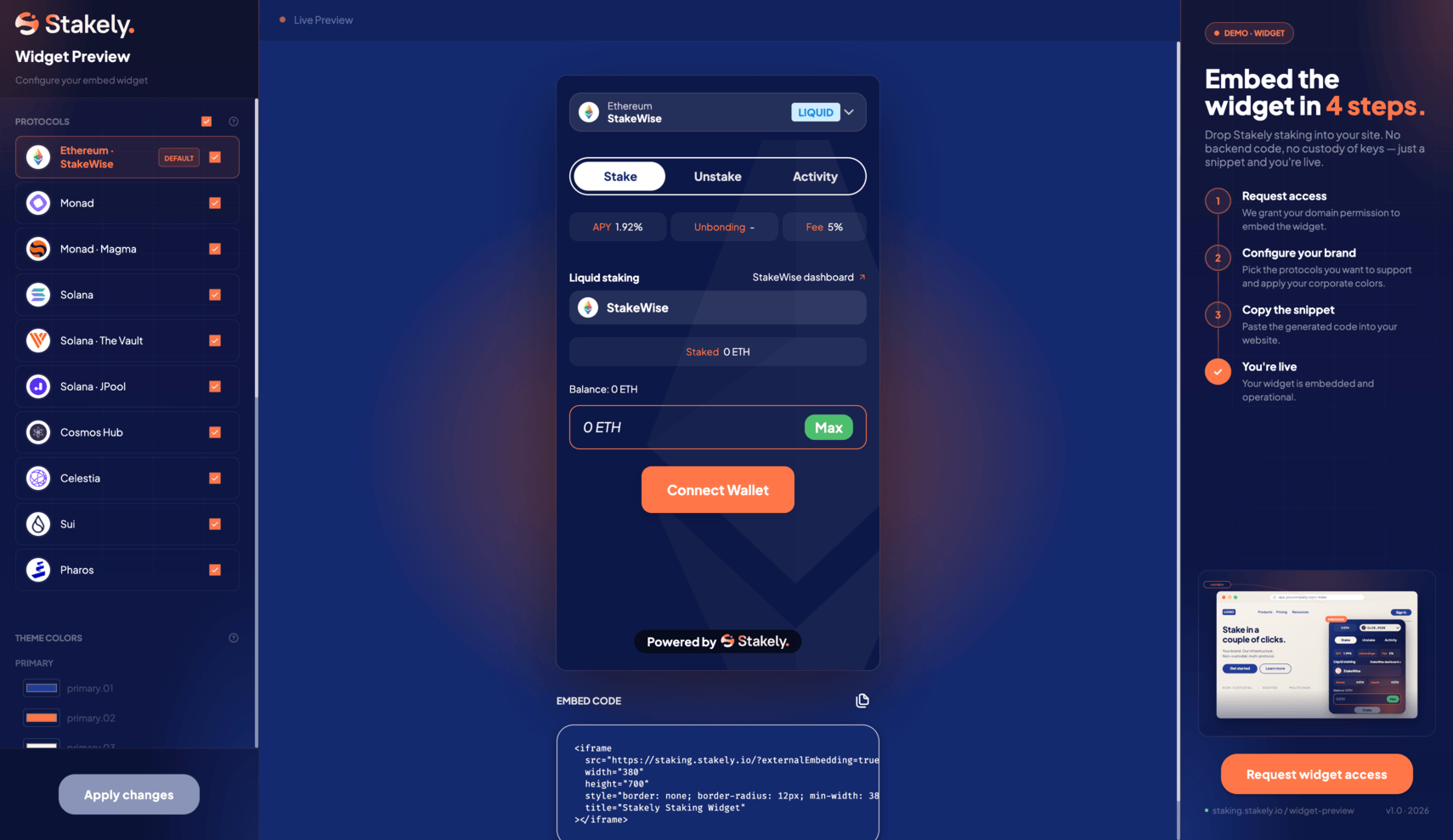
What the widget enables
The Staking Widget integrates a complete staking experience, configurable according to the networks and protocols the partner wants to display.
It is not just a visual component. In addition to delegating tokens, users can withdraw rewards, unstake, check their available balance, view the rewards generated and review the amount already delegated, while always keeping a non-custodial approach in which they remain in control of their assets.
For the partner, this turns staking into a product feature and opens a new business opportunity around Proof-of-Stake assets. For the user, it reduces steps and context switching. For Stakely, it is a way to bring our staking infrastructure to more environments without requiring every integration to solve the technical complexity behind it from scratch.
Staking as a new value layer inside the product
Staking can be more than an external action. When integrated properly, it can become an additional layer of value inside a platform that already works with digital assets.
Integrating staking directly makes it possible to:
- open a new business opportunity around staking;
- add a feature connected to Proof-of-Stake assets;
- reduce friction compared to redirect-based experiences;
- keep users inside an environment they already know;
- capture more value within the product's own experience;
- offer staking without taking on all the technical and operational burden internally.
The key point is this: the Staking Widget brings staking closer to where the user already is and allows the partner to keep control of the experience.
What it solves for integration teams
Integrating staking does not end with creating a good-looking screen. Each network has its own delegation logic, compatible wallets, transactions, validators, user states, rewards information and maintenance needs.
When several networks need to be supported, that complexity multiplies.
The Stakely Staking Widget reduces that burden by providing an experience ready to integrate and connected to Stakely's staking infrastructure. Its appearance can also be customized to better match the visual identity of the product where it is embedded.
Behind the scenes, the Staking Widget connects to the Stakely Staking API to solve the most complex part of the experience: interface, staking logic and transaction flows. This lets the partner focus on bringing staking into their product without building every piece from scratch.
Network, protocol and appearance configuration
The Staking Widget supports the networks available in the Stakely Staking App, with new networks planned as the product evolves.
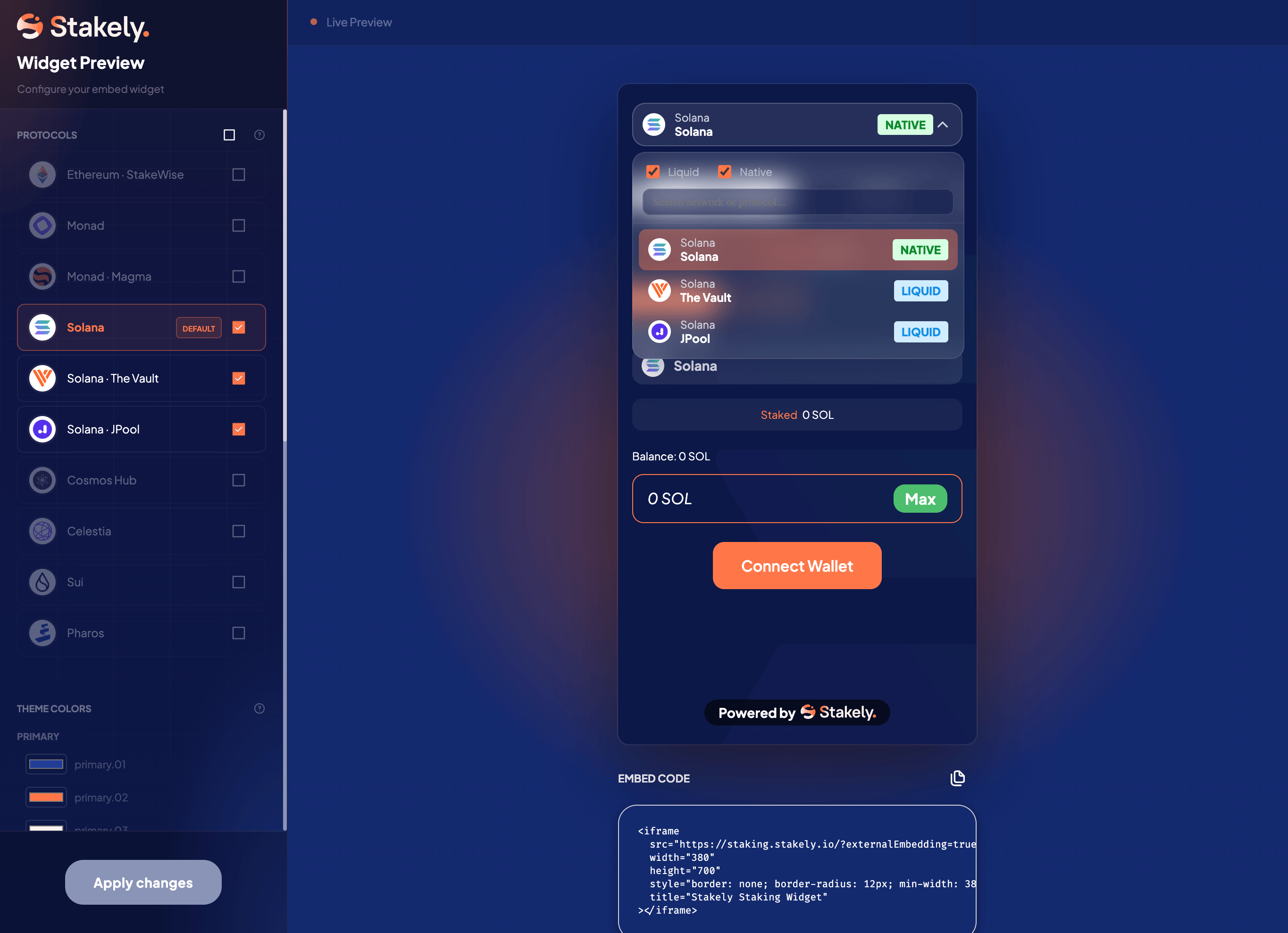
The partner can configure which networks and protocols they want to display from the blockchain selector. If they only want to offer staking for a specific network that is already supported, they simply need to select it in the tool and apply the changes.
They can also adapt visual elements of the widget so the experience fits better with their own brand. This makes it possible to integrate staking without making the flow feel like an external piece disconnected from the product.
For more specific cases, such as a network that is not yet available or an integration with particular requirements, the team can contact Stakely to evaluate the request.
A non-custodial approach, compatible with custody environments
One of the most important aspects of the Staking Widget is its non-custodial approach. Stakely does not custody the assets of the user or the partner integrating the widget: the flow is designed so transaction signing and asset control remain in the corresponding environment.
This allows the widget to adapt both to user experiences connected directly to a wallet and to products that work with custodians or external custody infrastructure. In both cases, Stakely provides the staking layer and operational infrastructure without becoming custodian of the funds.
For platforms that want to add staking responsibly, this distinction matters. It enables an integrated experience without turning staking into a custodial solution managed by Stakely or adding an unnecessary custody layer over the assets.
Staking infrastructure operated by Stakely
The value of the widget is not only in the interface. It is also in what sits behind it.
Stakely operates validators and infrastructure services across multiple Proof-of-Stake networks. That operational experience is the foundation behind the Staking Widget: supported networks, staking logic, validators, monitoring and technical knowledge applied to the product.
For teams integrating it, this means they do not need to become staking operators in order to offer staking. They can rely on a specialized partner while keeping the experience inside their own environment.
Try the Staking Widget
Before starting an integration, teams can test the flow in the Stakely Staking Widget demo.
The demo shows how an integrated staking experience could feel: network selection, flow configuration, visual customization and user experience from an interface built for third-party products.
If you want to bring staking into your product, you can try the widget and contact our team to request access, review the use case and approve the domain from which the integration will run.
The goal is clear: staking should be able to live where users already are, with a non-custodial, customizable experience supported by specialized infrastructure.