





Somnia Network: What it is, how it works, and why it matters for gaming, metaverses, and DeFi
In recent years, the blockchain conversation has evolved: it's no longer just about lowering fees, but about building infrastructures capable of supporting real-time, fully on-chain interactive experiences. Multiplayer games, virtual worlds, and social platforms require minimal latency, high throughput, and stable costs to scale effectively.
Somnia was created precisely for this scenario. It’s a network designed to bring these experiences to production without relying on Web2 architectures.
What is Somnia?
Somnia is an EVM-compatible Layer 1 blockchain designed for applications that require real-time responsiveness, such as gaming, metaverses, and on-chain social networks.
Its technical roadmap aims for over 1,000,000 TPS and sub-second finality, as outlined in its long-term vision. The mainnet has been live since September 2025.
Key features of Somnia
Some of Somnia’s key features include:
- EVM-compatible Layer 1 blockchain
- Focused on real-time and interactive experiences
- Performance optimized for gaming, metaverses, and social dApps
- Architecture based on MultiStream Consensus
- Ultra-fast state engine powered by IceDB
For developers, compatibility with the EVM environment means they can leverage familiar tools like Solidity, Hardhat, and Foundry, while also benefiting from substantial improvements in latency and transaction costs.
Additionally, its Shannon testnet — named after Claude Shannon (father of information theory) — serves as a performance testing and validation environment, with an explorer and utilities to iterate quickly before going to production.
How Somnia works: technical architecture in detail
Somnia is not just “another fast EVM chain.” It combines parallel execution, network optimization, and a storage system designed to scale without bottlenecks. Its design is built on three pillars:
1. MultiStream consensus
Somnia’s consensus mechanism separates data production from block finalization.
Each validator maintains its own data chain in parallel, while a consensus chain aggregates the “headers” of all data chains and finalizes blocks using a modified PBFT on top of Proof-of-Stake (PoS).
This reduces validator contention, increases throughput, and maintains security guarantees against local forks.
2. IceDB: state database with nanosecond operations
The second pillar is IceDB, a deterministic high-performance database engine. Read and write operations execute in tens of nanoseconds, with built-in snapshotting to maintain a consistent state under heavy load.
Thanks to this design, the storage layer is no longer a congestion point for the system.
3. Accelerated EVM and optimized network
Somnia offers full EVM compatibility and supports common tooling, while enhancing execution through:
- Stream compression
- Signature aggregation
- Optimized node-to-node communication
For teams familiar with Ethereum, the migration process is nearly seamless.
Token and economy: SOMI
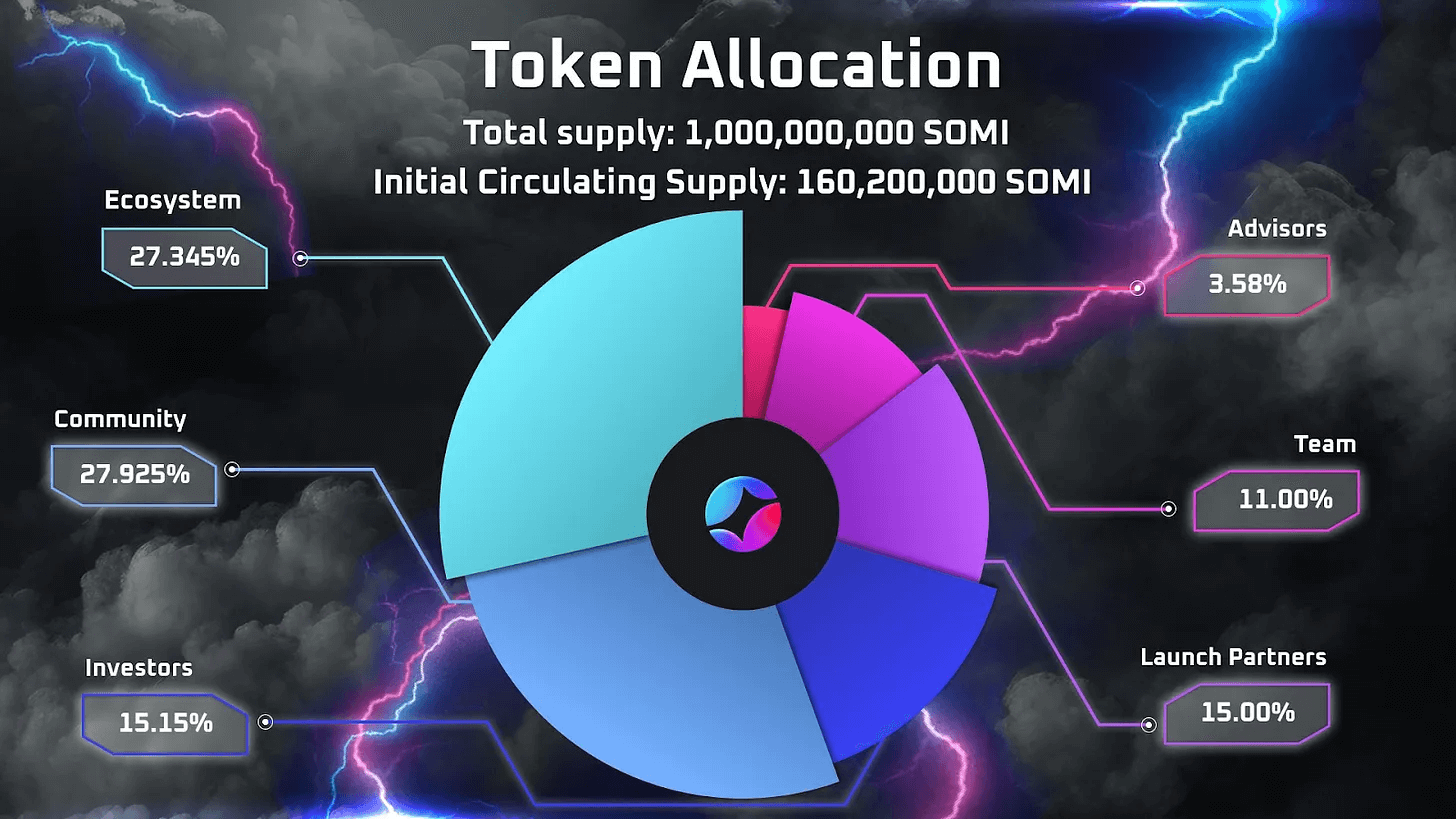
While in testnet, the token is STT; on mainnet, the token is SOMI, with a fixed supply of 1 billion SOMI.
Use it within the ecosystem for payments, escrow systems, donations and tipping, sponsored gas via Account Abstraction, or for staking and participating in governance through voting.
Since its TGE, the network applies a deflationary mechanism that burns 50% of transaction fees, while the remaining 50% is distributed among validators based on their stake. The unlock schedule extends up to 48 months after launch, as outlined in the unlock calendar.
Supply distribution:
Use cases for Somnia: performance and dev experience
Somnia is built for real-time experiences, enabling new on-chain use cases:
- On-chain gaming: persistent logic and assets with intensive interaction; low latency is key for real-time synchronization.
- Metaverses and virtual worlds: portable identities, objects, and internal economies with instant transactions and minimal costs.
- Social and creator platforms: social flows, content, and reputation with on-chain settlement and a near-Web2 UX.
- Low-latency DeFi: orchestrating orders and markets with fast finality and minimal fees.
Developer notes:
- EVM DX: deploy with Hardhat, Foundry, or Remix; compatible with OpenZeppelin and familiar gas model for Ethereum developers.
- Bridges: the official documentation estimates between 1 and 10 seconds for typical transactions, depending on service and network.
Final thoughts
Somnia combines EVM compatibility with a data and execution architecture optimized for real time. With MultiStream and IceDB, it scales throughput without sacrificing latency, while the SOMI economic model aligns network usage, staking-based security, and fee burns that balance activity with supply.