





Aztec Network: Programmable privacy on Ethereum
Aztec Network is a layer 2 solution on Ethereum designed to address one of its structural limitations: the lack of native execution-level privacy. While all transactions and states on Ethereum are public by default, Aztec proposes a model where privacy is a fundamental property of the protocol, not an optional layer.
To achieve this, Aztec leverages zero-knowledge proof (ZK) cryptography, enabling smart contracts to execute privately and only publishing the necessary proofs to Ethereum to verify that execution was correct. This way, Ethereum’s security and decentralization are preserved without exposing sensitive information.
In this article, we explore what Aztec Network is, how it works, and why it's becoming a key component for privacy on Ethereum.
What is Aztec Network
Aztec Network is a zk-rollup focused on private execution. Its architecture clearly separates two domains:
- Private execution, which takes place locally on the user's device.
- Public settlement, which is performed on Ethereum.
Aztec’s model allows each application to define very precise privacy rules. A contract can decide which data is public, which remains private, and under what conditions certain information may be revealed. The result is a new standard of programmable confidentiality that maintains compatibility with Ethereum and its ecosystem.
Thanks to this design, Aztec is especially suitable for private finance, decentralized identity, anonymous voting, hidden-logic gaming, or enterprise applications that require confidentiality without sacrificing on-chain verification.
Protocol design principles
Aztec’s architecture is based on three core principles:
- Programmable privacy: Each smart contract defines, in granular detail, which parts of its state and logic are public and which remain private. Unlike Ethereum, where everything is transparent by default, in Aztec, privacy is part of the contract’s design.
- Private execution: Sensitive data never leaves the user’s device. The network doesn’t process plaintext information, but rather cryptographic proofs that validate execution without revealing its content.
- Private composability: Privacy is preserved even when contracts interact with each other, allowing for the construction of complex systems without losing confidentiality.
Technical architecture: How does Aztec work?
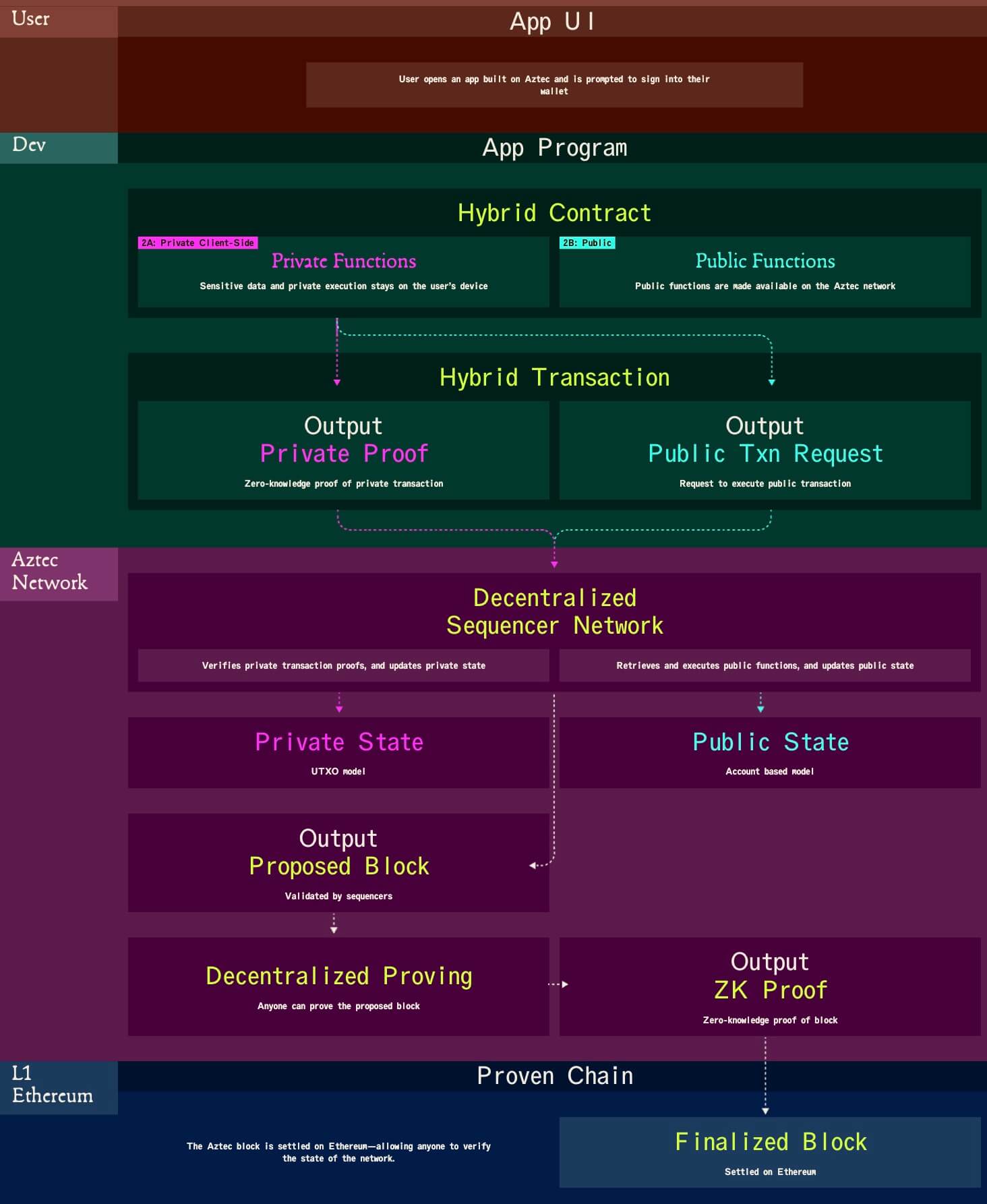
On a technical level, Aztec adopts a hybrid architecture designed to balance privacy, interoperability, and scalability, while keeping Ethereum as the security layer. The private state is managed via an encrypted UTXO-like model, optimized to protect users’ sensitive information. Meanwhile, the public state uses an account-based model compatible with Ethereum, facilitating integration with existing tools, wallets, and infrastructure.
How? Transactions are executed privately off-chain, on the user’s device, where zero-knowledge proofs are generated to demonstrate validity. Sequencers are responsible for ordering these transactions and publishing only the necessary verification data to Ethereum—without ever accessing private information. This role is designed to become progressively decentralized.
The proof generation system is open, allowing any participant to act as a prover. Ultimately, the entire rollup state is anchored to Ethereum, inheriting its security guarantees without its full computational cost.
Noir: Aztec’s zk language
One of the unique elements of the Aztec ecosystem is Noir, a domain-specific language for building zero-knowledge circuits and contracts.
Noir abstracts much of the cryptographic complexity, allowing developers to focus on business logic. As a result, building private applications is no longer reserved for cryptography experts, which has accelerated experimentation on testnet and the exploration of new use cases on Aztec.
What sets Aztec apart from other L2s
Its value proposition includes:
- Private execution by default.
- Full control over what data is published and what remains encrypted.
- Hybrid architecture combining privacy and interoperability.
- Open infrastructure, with sequencers and provers designed for decentralized operation.
- Composable privacy, even in complex flows and across applications.
Project status and protocol economics
Aztec has been live on mainnet since November 20, 2025, after reaching 500 validators in the activation queue and completing the initial sale of its AZTEC token.
In this initial phase, the network already supports block production and AZTEC token staking, although functionality remains limited. The full private smart contract execution layer will be rolled out gradually, with a roadmap extending through 2026.
The AZTEC token plays a central role in the protocol’s security, governance, and economic incentives. Its main use cases include staking, participating in governance, and incentivizing infrastructure operators such as sequencers and provers.
To participate in Aztec, a minimum of 200,000 AZTEC must be staked. Keep in mind that the final tokenomics model and the exact timeline for the Token Generation Event (TGE) are tentatively scheduled for February 2026, at which point it will be subject to the protocol’s governance processes.
Conclusion: Why Aztec matters
By introducing programmable privacy as a core protocol property, Aztec paves the way for a new generation of verifiable and confidential applications.
For developers, it provides tools to innovate without compromising privacy; and for stakers, an economic system designed to sustain the network long-term.
Stake AZTEC with Stakely to be part of one of the most significant milestones in Ethereum’s ecosystem in the coming years.