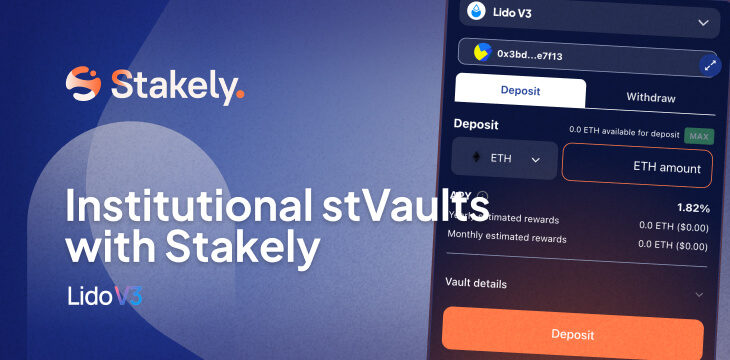






Stakely launches its stVault on Lido V3: ETH staking with Lido EarnETH
On Ethereum, staking has traditionally meant choosing between two paths: running your own validator, with the 32 ETH and infrastructure it requires, or using a simpler staking product that does not always make it clear what sits behind the position.
With Lido V3 stVaults, that distinction becomes broader. Its stVault architecture makes it possible to build products that combine validator operations with specific ETH and stETH strategies.
That is why we are launching the Stakely stVault: a public vault that combines ETH staking through validators operated by our team with Lido EarnETH, Lido's public DeFi strategy. Anyone can participate through the product interface, without running their own validator or holding the 32 ETH required to activate one.
ETH staking with an additional strategy

The Stakely stVault starts with ETH staking.
Deposits are pooled and used to operate validators managed by Stakely. This gives participants access to staking rewards without having to manage validator keys, infrastructure, or day-to-day operations themselves.
On top of this foundation, the vault integrates Lido EarnETH. The strategy uses ETH and stETH across selected DeFi protocols to add another layer to the rewards generated through validation.
The idea is not to make users manage a staking position and a DeFi position separately. The Stakely stVault brings both together in one experience.
stETH is used as part of the vault's internal strategy, so users do not need to receive or manage it directly in their wallets.
A new use for Lido V3 infrastructure
The stVaults turn staking into more flexible infrastructure. They allow an operator like Stakely to build a product around its own validators and combine it with the liquidity and composability possibilities of stETH.
The Stakely stVault belongs to this new layer of public products built on Lido V3: a way to participate in ETH staking that maintains a clear relationship with the validator operator while adding an integrated DeFi strategy.
For a deeper look at the architecture behind it, our article on Lido V3 and stVaults explains how this model can support different staking experiences.
The infrastructure behind the vault
The strategy is one part of the product. The other is the infrastructure operating the validators.
At Stakely, we have been operating nodes and validators since 2020. For Ethereum, we use a distributed architecture, continuous monitoring, and operational controls designed to maintain availability and reduce validation-related risks.
We also hold an ISO/IEC 27001:2022 certification and a SOC 2 Type II report, two relevant references for assessing our information-security and operational processes.
You can learn more about our operational approach in our article on how Stakely protects delegated assets.
stVaults: a solution for institutions
The Stakely stVault is now available for anyone who wants to access ETH staking through Stakely-operated validators and an integrated DeFi strategy built on Lido V3.
Access the product at staking.stakely.io!