





Story becomes The DATA Foundation: what it means for AI data infrastructure
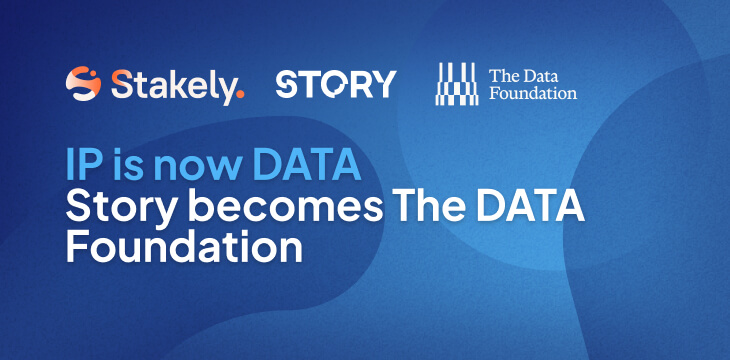
Story is entering a new stage. The network previously known as Story is becoming The DATA Foundation, the IP token becomes DATA, and Story Network is being renamed DATA Network.
This is not just a branding change. In its official announcement, the team explains that the network is shifting its thesis from programmable intellectual property toward an infrastructure layer focused on verifiable, confidential, and licensable data for AI.
The idea behind it is clear: if AI models need higher-quality data with verifiable provenance and clear rights, they also need infrastructure that can prove where that data comes from, under what conditions it was contributed, and how it can be used.
That is where The DATA Foundation wants to position itself.
From programmable IP to verifiable data
Story was born around a thesis focused on onchain intellectual property: turning IP into a programmable, licensable, and traceable asset. That idea remains part of the picture, but it is now being integrated into a broader thesis: data as a critical asset for the AI economy.
The team acknowledges that some traditional IP verticals, such as entertainment, gaming, and brands, faced more friction than expected. Companies that control highly valuable assets tend to protect them closely, and the openness of permissionless infrastructure does not always fit that need for control.
However, that learning led them toward a use case with stronger traction: AI training data.
The new thesis starts from a real problem. AI labs need data at scale, but not all data is useful. It is becoming increasingly important to answer three basic questions:
- where the data comes from;
- whether there is consent or clear rights to use it;
- whether it has enough quality to train models.
The DATA Foundation wants to build the infrastructure that connects those three pieces.
What is DATA Network?
DATA Network is an EVM-compatible Layer 1 that combines EVM execution with a CometBFT-based consensus layer. The DATA Foundation describes the network as infrastructure designed so that any data can have provenance, confidentiality, and programmable rights.
The proposal is built around three main layers:
- Trace, to record provenance, content hashes, consent, and audit signals.
- CDR, or Confidential Data Rails, to keep data encrypted and control decryption through onchain permissions.
- IP & Licensing, to register data as intellectual property assets and attach transparent licensing terms to them.
Put simply: DATA Network wants data to be more than files moving between companies, models, and platforms. It wants data to become an asset with a verifiable history, usage conditions, and access control.
This is especially relevant in AI, where data provenance is becoming a technical, legal, and reputational issue.
Why this change matters
Story's shift toward The DATA Foundation points to a broader trend: blockchain infrastructure is starting to find space in problems where traceability and coordination between parties are not optional.
In AI, the data problem is not only about getting volume. It is also about proving provenance, consent, quality, licenses, and payments to contributors. Solving all of that through manual processes is slow, expensive, and difficult to audit.
The DATA Foundation is trying to bring that logic into onchain infrastructure where data can have:
- public traceability without necessarily exposing the content;
- programmable licenses attached to each asset;
- confidentiality through controlled access;
- payments to contributors, including stablecoin rails;
- verifiable auditability for buyers, contributors, and regulators.
The interesting point is not only that the network is changing its name. It is that it is changing the question it is trying to answer. It is no longer just about how to license IP onchain, but how to build infrastructure where the data used by AI can be verifiable, usable, and governed by clear rules.
What happens to $IP, $DATA, and the network
For users, builders, validators, and ecosystem partners, the announcement leaves several important takeaways.
The $IP token migrates to $DATA in a one-to-one conversion, with no action required from holders for now. The team also warns that any instruction to manually migrate tokens should be treated with caution and that valid information must come from official channels.
For builders, existing integrations should not break. Documentation, RPCs, SDKs, and naming references have already been updated.
For validators and ecosystem partners, the network continues operating without interruption, and the validator set is not changing at this time.
This is important because it separates the strategic shift from the technical operation of the network: the identity and focus change, but the infrastructure continues to run.
Kled, Trace, and the new focus on human data
One of the most relevant parts of the announcement is the integration of Kled, presented by The DATA Foundation as one of the largest opt-in human data marketplaces.
Kled will begin operating on DATA Protocol, using the network infrastructure to register licenses, contributor receipts, and verifiable audits. Its founder, Avi Patel, is also joining the Foundation as Chief Data Officer while continuing his role at Kled.
This move helps explain The DATA Foundation's direction: it does not want to offer only a generic network, but to build around concrete use cases where data traceability already has demand.
It also fits with tools like Trace, which acts as a public audit and search surface for assets registered on DATA Network. Trace makes it possible to query records, filter datasets, and review elements such as hashes, consent, licenses, payment status, and lifecycle logs, while keeping contributor identities anonymized and data confidential.
Why this has an infrastructure angle
From the outside, this may look like a rebrand. But for any blockchain infrastructure operator, the relevant part sits somewhere else.
The DATA Foundation is trying to turn a network into a specialized layer for data, rights, and confidentiality. That requires much more than narrative: it needs network availability, builder tooling, reliable RPCs, validators, explorers, documentation, auditability, and a technical experience that reduces friction for companies and applications.
If the AI data market moves toward models where provenance, consent, and quality must be proven, the infrastructure supporting those records becomes critical.
It is not enough to say that data is usable. It has to be provable.
And that is where blockchain can contribute something meaningful: not as a buzzword, but as a coordination and verification system between contributors, buyers, platforms, regulators, and applications.
What comes next
The DATA Foundation outlines several next steps: Kled integration starts with the announcement, Numo continues scaling contributions, Oto and Miso will expand the network in the coming weeks, and CDR is expected to reach mainnet in Q3.
The key will be watching how this transition evolves and whether DATA Network can turn its new thesis into sustained real usage. The direction is relevant because it touches a specific need in the AI market: data with verifiable provenance, rights, and quality.
For Stakely, this type of move matters because it shows where part of blockchain infrastructure is heading: more specialized networks, more concrete use cases, and higher demands on the operational layer that supports them.
If The DATA Foundation executes this vision, the shift from Story to DATA will not be just a rebrand. It will be another signal that onchain infrastructure is starting to play an important role in the data economy.