





Ethereum staking withdrawal types, exit queues and waiting times
Ethereum withdrawals can refer to several different operations: closing a validator and recovering its balance, withdrawing some ETH while keeping it active, or receiving the excess accumulated above its maximum effective balance.
All three send ETH to a withdrawal address, but they have different triggers and waiting times. Knowing which applies tells you whether you need to submit a request, wait in a queue or simply wait for the next automatic payment.
The different types of Ethereum withdrawals
Full withdrawal when closing a validator
A full withdrawal returns a validator's entire remaining balance after it leaves the active set. This includes the ETH it holds and any rewards still in its balance, less any penalties applied.
The validator must first initiate an exit. Once it has exited, it stops validating, and its balance is subsequently sent to its withdrawal address. This route is available to validators with either 0x01 or 0x02 credentials.
Requested partial withdrawal to reduce the balance
A requested partial withdrawal removes a specified amount of ETH from a 0x02 validator without closing it, leaving at least 32 ETH and meeting the protocol's eligibility requirements.
For example, a validator holding 100 ETH could withdraw 20 ETH and remain active with approximately 80 ETH. Its final balance will also reflect rewards and any penalties during that period.
This flexibility is part of the changes introduced by Pectra. A request can reduce a staking position or collect rewards accumulated within it: the protocol processes an amount of ETH, without treating principal and rewards as separate accounting categories.
Automatic withdrawal of excess balance
Ethereum can also automatically send out the balance above a validator's maximum effective balance. This is how rewards are normally paid out for traditional 32 ETH validators.
Technically, this automatic payment is also a partial withdrawal: part of the balance leaves while the validator remains active. We distinguish it from a requested partial withdrawal because the trigger and waiting period differ.
To understand when this happens, we need to look at maximum effective balance.
How maximum effective balance affects reward withdrawals
A validator's total balance is the ETH it holds. Its effective balance is the amount Ethereum uses to weight its participation in consensus and calculate its rewards. The two can differ.
The maximum effective balance depends on the validator's credentials:
| Credentials | Maximum effective balance | Balance eligible for automatic withdrawal |
|---|---|---|
| 0x01 | 32 ETH | The balance above 32 ETH. |
| 0x02 | 2,048 ETH | The balance above 2,048 ETH. |
For an automatic payment, the effective balance must have reached the relevant maximum and the total balance must exceed it.
A 0x01 validator with an effective balance of 32 ETH and a total balance of 32.6 ETH can therefore receive the excess 0.6 ETH automatically. For a 0x02 validator with an effective balance of 2,048 ETH and a total balance of 2,049 ETH, the excess would be 1 ETH.
The 2,048 ETH threshold caps effective balance, not total balance. This is why a validator can hold ETH above that threshold.
Nor is it enough for the total balance to exceed the validator's current effective balance: the automatic sweep uses the maximum for its credential type.
This distinction matters when discussing “withdrawing rewards”. If a 0x02 validator grows from 100 to 101 ETH, the additional ETH is not automatically paid out simply because it is a reward. It can contribute to growth in effective balance under the protocol's rules. Withdrawing it while keeping the validator active requires a partial withdrawal request.
An automatic payment sends the entire eligible excess; you cannot select a portion as you would with a manual request. These are the conditions for Ethereum's automatic withdrawals.
How long each withdrawal takes
Full withdrawal waiting time
Once the request is accepted, Ethereum assigns an exit epoch according to the available capacity and the balance already waiting to exit. An epoch lasts approximately 6.4 minutes.
Until its effective exit, the validator remains active and must continue performing its duties. Waiting times increase when exit demand rises; even an empty queue does not eliminate the protocol's scheduling delay.
A further 256 epochs must then pass: 27 hours, 18 minutes and 24 seconds under current mainnet parameters. This period begins at the effective exit, not when the user clicks “withdraw”.
The balance then becomes eligible for the withdrawal sweep, Ethereum's recurring pass through validators to process eligible payments. When the sweep reaches the validator, its balance is credited to the withdrawal address.
Total time: request processing + time until the effective exit + approximately 27 hours and 18 minutes + time until the sweep.
This distinction between exiting and becoming eligible to withdraw explains why an exit queue estimate may not tell you when the ETH will arrive. This sequence describes an ordinary exit without slashing; a slashing event can extend the waiting period.
Requested partial withdrawal waiting time
A partial withdrawal request is submitted from the withdrawal address through an execution-layer transaction, incurring gas and the applicable request fee.
Although the validator stays active, the requested amount consumes exit capacity, shared with full exits. Ethereum assigns it an epoch based on that capacity, then adds another 256 epochs before the withdrawal becomes eligible.
The payment is subsequently processed through the pending partial withdrawals list, which is subject to per-block limits. This is separate from the ordinary validator sweep.
Total time: request processing + waiting for exit capacity + approximately 27 hours and 18 minutes + partial payment processing.
Keeping a validator active therefore does not exempt a requested partial withdrawal from the protocol's waiting period. Equally, you should not automatically add a complete ordinary sweep cycle to its timeline. Partial withdrawal processing has its own pending payments list.
Automatic excess withdrawal waiting time
Once a validator meets the conditions for automatic excess withdrawal, it does not need to request an exit or add the 256-epoch delay.
It only needs to wait for the sweep to reach it and process the payment. No user transaction or gas is required.
Waiting time: the remaining time until the sweep processes the eligible excess.
This depends on the sweep's position, the withdrawals to be processed and block production. It can take several days, but there is no fixed interval that applies to every validator.
If the validator is not yet eligible, waiting for the next sweep is not enough. This applies to rewards in a 0x02 validator whose balance remains below 2,048 ETH: collecting them requires a partial withdrawal request.
Comparing withdrawal timelines
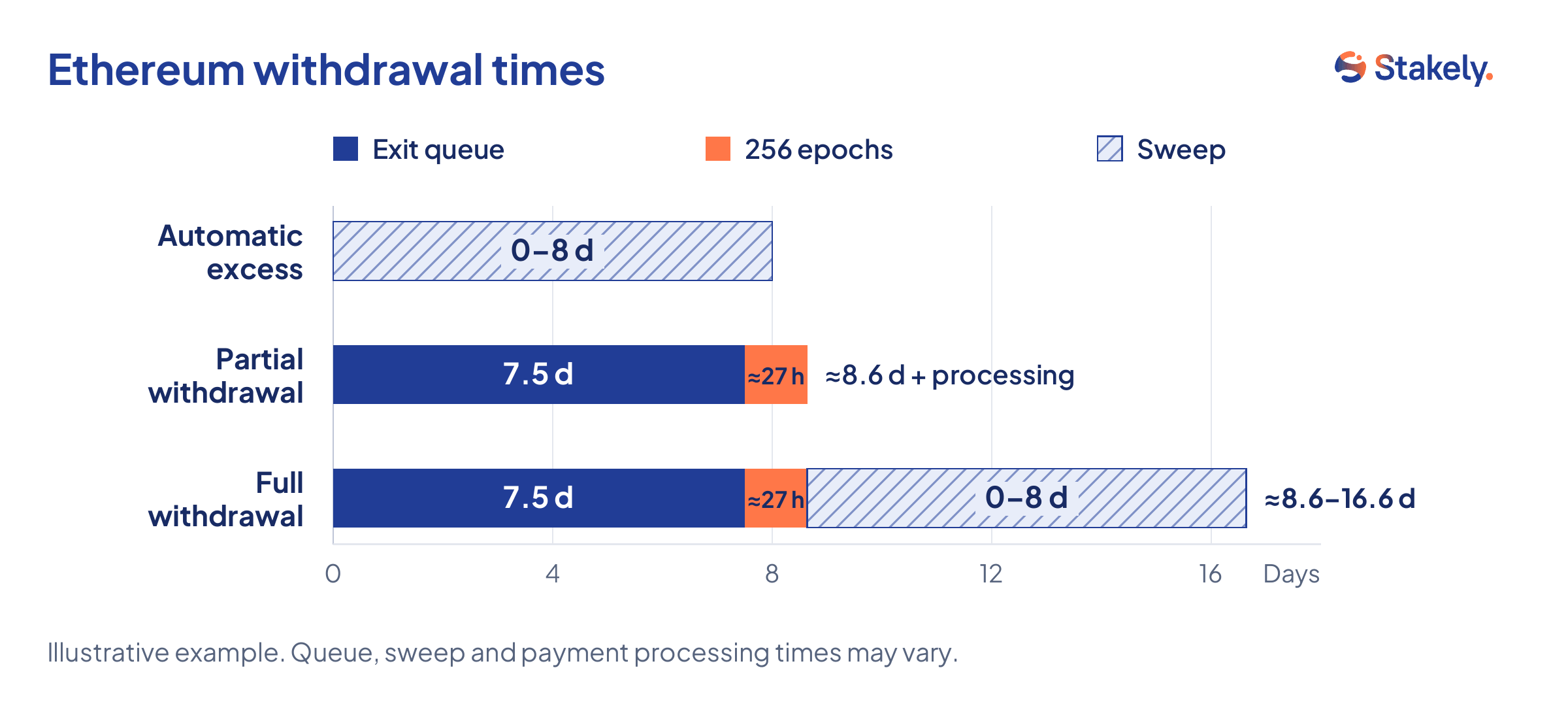
Illustrative example assuming 7.5 days until the assigned epoch and a sweep wait of 0–8 days. These assumptions compare the different routes; they are neither current network readings nor guaranteed maximums. A partial withdrawal adds payment processing, while a full withdrawal includes the sweep. The example starts with an accepted request or eligible excess.
The question “how long does it take to withdraw my rewards?” therefore needs one more detail: will Ethereum send an eligible excess automatically, or does the balance require a withdrawal request? The ETH can have the same origin while following a different mechanism and timeline.
These timelines cover the transfer from the validator to its withdrawal address. If that address belongs to a pool or vault contract, additional steps may be needed before the ETH reaches the user's wallet. When reviewing Ethereum staking options, check how each product handles that final stage too.