





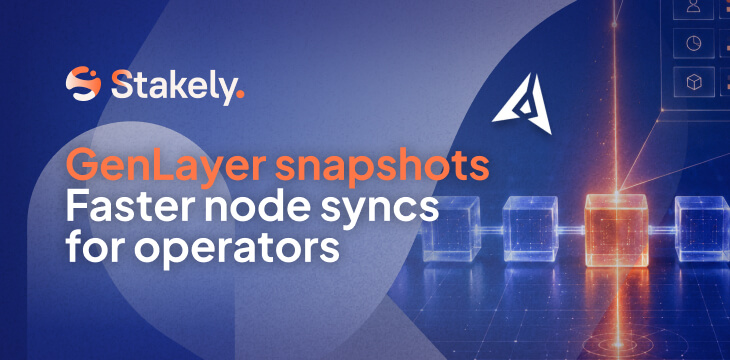
GenLayer snapshots: reducing node synchronization time
Starting a node from scratch can be one of the slowest parts of an operator's work. Before it can be used normally, the node needs to catch up with the state of the network, which can mean waiting for it to synchronize from the beginning.
To reduce that friction, Stakely has developed a free snapshot service for GenLayer, available at genlayer-snapshots.stakely.io. The goal is to help operators start from a recent state of the node database instead of syncing from scratch.
It is a contribution designed as a public good for the GenLayer community. It does not change the rules of the protocol or replace good operational practices, but it does solve a very specific problem: making it faster, more verifiable, and more accessible for technical operators to start or recover a node.
What is a snapshot?
A snapshot is a copy of the state of a database at a specific point in time. In blockchain networks, it allows a node to be restored from a recent point, avoiding the need to rebuild the full history from the beginning.
For an operator, this can be useful when deploying a new node, recovering infrastructure after an issue, preparing test environments, or reducing the initial time before starting operations. Instead of waiting for a full synchronization from scratch, the node can start from a recent state and continue from there.
In a network like GenLayer, focused on Intelligent Contracts and an infrastructure where nodes participate in execution, evaluation, and consensus processes, reducing this operational friction matters. Snapshots are not a flashy tool, but they are practical: they help reduce waiting time, simplify deployments, and support infrastructure recovery from a recent state.
How the service works
The service is available at genlayer-snapshots.stakely.io and lets operators browse the snapshots available for each network.
For each snapshot, the page includes:
- generation date;
- file size;
- verification hash;
- direct download link;
- restore instructions.
The idea is that any operator can check which snapshot they need, download it, verify it, and restore it through a clear flow.
Downloads are also served through a CDN, helping keep the process fast regardless of where the node is being operated from.
Daily snapshots, updated automatically
The system generates a fresh snapshot every day for each supported network. This allows operators to work with recent states and avoid relying on outdated files or manual processes.
The service currently covers testnet and is prepared to extend support to mainnet when GenLayer activates it.
This daily update cadence matters because a snapshot becomes less useful when it is too far from the current network state. The more recent it is, the less time the node will need to catch up after restoration.
How to use GenLayer snapshots
The flow is simple:
- Go to genlayer-snapshots.stakely.io.
- Select the network for which you need a snapshot.
- Check the file date, size, and hash.
- Download the snapshot from the available link.
- Verify the downloaded file.
- Follow the restore instructions shown on the page.
- Start your node from the restored state.
The goal is not to replace GenLayer's technical documentation, but to make one specific part of the process easier: starting from a recent state to reduce synchronization time.
A practical contribution for operators
At Stakely, we operate validators and infrastructure services across more than 30 networks. That experience helps us identify operational needs that are not always visible to end users, but directly affect the teams maintaining infrastructure.
The GenLayer snapshot service comes from that logic: identify a concrete friction point for operators and turn it into a public, maintained, and easy-to-use tool.
With genlayer-snapshots.stakely.io, the GenLayer community has access to a free resource, updated daily and designed to make node operations easier on testnet, with mainnet support planned when it becomes available.
If you want to support operators that contribute practical infrastructure to the GenLayer ecosystem, you can stake on GenLayer with Stakely and delegate to a validator actively supporting the network.