





What is Avalanche: Complete guide to its architecture, AVAX, and L1s
Avalanche is a multichain blockchain infrastructure designed to host both applications on a shared EVM network and sovereign networks with their own rules.
Its ecosystem is built around the Primary Network, a special Avalanche L1 made up of three chains: C-Chain, P-Chain, and X-Chain; as well as other Avalanche L1s that can customize their validators, token economy, permissions, and execution logic.
In this guide, we will explore what Avalanche is, how its architecture works, what role AVAX plays, and why Avalanche L1s have become a key part of its technological proposition.
What is Avalanche
Avalanche is a blockchain network based on Proof-of-Stake and designed as a heterogeneous infrastructure: instead of concentrating all activity on a single general-purpose chain, it allows different blockchains to coexist within the same ecosystem. This architecture makes it easier for each network to be optimized for a specific use case.
How Avalanche works: The architecture of the Primary Network
To understand Avalanche, you first need to understand its Primary Network. The official documentation defines it as a special Avalanche L1 made up of three blockchains: C-Chain, P-Chain, and X-Chain.
C-Chain
The C-Chain is Avalanche’s smart contract chain. It implements the Ethereum Virtual Machine, supports the Geth API, and allows contracts written in Solidity to be deployed. That is why it is often the most direct option for teams that want to launch an EVM dApp without creating their own network.
P-Chain
The P-Chain coordinates platform-level operations. Among other functions, it manages validators, staking, the creation of new blockchains, and operations related to Avalanche L1s. It is a central component for the organization and security of the ecosystem.
X-Chain
The X-Chain is focused on the creation and transfer of Avalanche Native Tokens. Although it was historically associated with Avalanche’s DAG model, after the Cortina upgrade it was linearized and began operating as a fully ordered blockchain with Snowman++. For this reason, it is no longer necessary to describe the X-Chain of the main network as a DAG-based chain.
Key changes in Avalanche’s architecture: Cortina, Etna, and Avalanche9000
Avalanche’s architecture has evolved significantly in recent years. Two milestones help explain its current state: Cortina and Etna, the upgrade associated with Avalanche9000.
Cortina and the Linearization of the X-Chain
The Cortina upgrade migrated the X-Chain so that it would run with Snowman++ and operate as a fully ordered blockchain. This change reduced the complexity of the previous design, improved compatibility with tools and integrations, and laid the groundwork for stronger interoperability between networks in the ecosystem.
Etna and Avalanche9000
The Etna upgrade, activated on mainnet on December 16, 2024, introduced the current Avalanche L1 model. This change lowered the barriers to launching sovereign networks, enabled more flexible validation, and removed the need for L1 validators to also validate the entire Primary Network.
This does not mean that L1s are completely isolated from the main network: their validators still synchronize the state of the P-Chain for functions such as validator tracking and interoperability. The key difference is that they no longer have to validate the C-Chain, P-Chain, and X-Chain as they did under the previous Subnets model.
What are Avalanche L1s?
Avalanche L1s are sovereign networks that define their own membership, validation, and tokenomics rules. An Avalanche L1 is made up of a dynamic subset of validators that reach consensus on one or more blockchains. In turn, each blockchain belongs to a single L1, while the same L1 can validate several blockchains.
One of their main advantages is flexibility. An Avalanche L1 can have its own native token, its own fee model, custom virtual machines, specific hardware requirements, or specific rules for its validators. This makes it possible to create public networks, private networks, or permissioned environments adapted to regulatory or business needs.
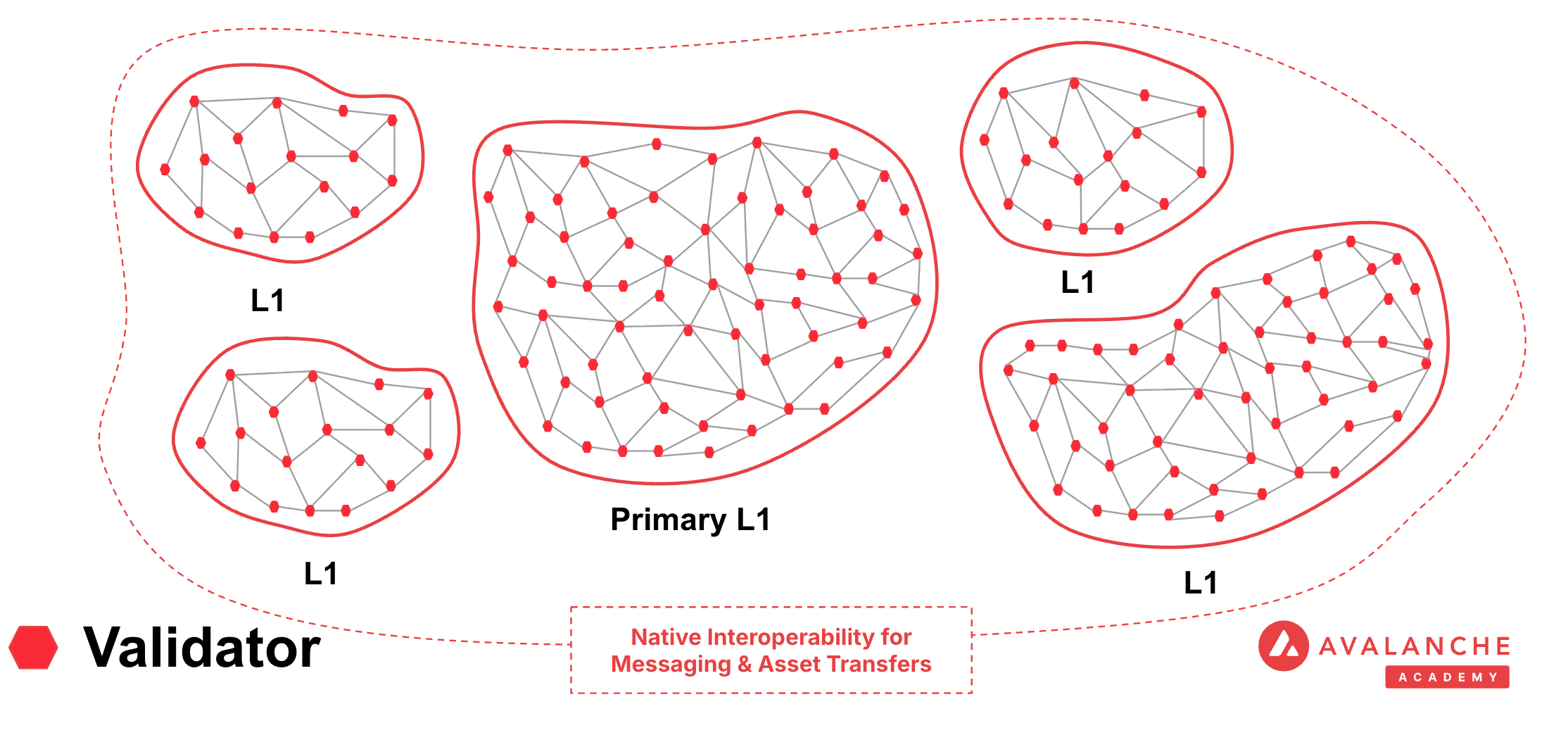
In addition, the performance of each L1 is isolated from the rest of the ecosystem. In other words, congestion or intensive use on one network should not directly affect the performance of other Avalanche L1s.
Interoperability: Avalanche Interchain Messaging
Avalanche does not present its L1s as completely disconnected networks. To facilitate communication between them, the ecosystem has Avalanche Interchain Messaging, or ICM, a protocol that enables native communication between Avalanche L1s.
ICM allows different L1s to exchange messages without relying on a centralized protocol. The authenticity of messages is verified through BLS signatures and validator information registered on the P-Chain.
For this reason, Avalanche’s multichain model is not simply about launching many separate networks, but about creating specialized networks that can coordinate with each other on a common technical foundation.
When to use the C-Chain and when to use an Avalanche L1
The C-Chain is the natural option when a team wants to quickly deploy an EVM dApp, leverage familiar tooling, and operate within a shared network. It is the most direct path for products that do not need to control the underlying infrastructure.
An Avalanche L1, on the other hand, makes more sense when a project needs to design a network with its own rules. This may include a native token used as gas, a specific validator set, permission controls, performance isolation, or specific regulatory requirements.
Put simply: the C-Chain is ideal for deploying an application, while an Avalanche L1 is the right option when the goal is to build a network.
What role does AVAX play in Avalanche?
AVAX is the native token of Avalanche. It is used to pay fees, secure the network through staking, and act as a reference unit within the ecosystem. Its supply is capped at a maximum of 720 million AVAX.
Its economic model combines three elements: reward issuance for validators, fee burning, and a maximum supply cap.
In addition, unlike other PoS networks, Avalanche does not apply classic slashing to locked stake. If a validator fails to meet the network’s requirements, they may lose their rewards, but not their principal deposit.
Conclusion
Avalanche is a multichain infrastructure that makes it possible to deploy applications in a familiar EVM environment or create sovereign networks with their own rules. Its evolution toward the Avalanche L1 model reinforces its approach as a platform for customized, interoperable blockchains adapted to different use cases.
That flexibility is what makes Avalanche one of the most relevant proposals in blockchain infrastructure.
Want to participate in the network? Stake AVAX with Stakely and stake easily and securely.