





Discover liquid staking on Monad with Magma and join Stakely’s gVault

Liquid staking is an important piece of Monad’s DeFi ecosystem, and Magma is one of the protocols already building in that direction.
Compared to native staking, Magma lets users delegate MON and receive gMON in return, a liquid asset that can be better integrated into DeFi strategies. In addition, with its gVaults, it introduces a way to gain exposure to specific validators, such as Stakely.
In this article, we explain what Magma is, how its architecture works, and how you can join Stakely’s gVault.
What is Magma
Magma is a liquid staking protocol built on Monad. It allows users to deposit MON and receive gMON in return, a token that represents their position within the protocol.
Its value proposition is simple: participate in staking without giving up the liquidity of that position entirely. Rather than relying solely on traditional delegation, Magma combines the underlying staking position with an asset designed to integrate more efficiently into DeFi.
Beyond issuing a liquid token, Magma adds an architecture that separates the aggregated staking layer from the validator-specific exposure layer.
What is gMON
gMON is the token you receive when you deposit into Magma. It represents your position within the protocol and follows a reward-bearing, non-rebasing model: your balance does not increase automatically, but the value of each gMON unit does increase as rewards from the underlying staking accumulate.
From a technical perspective, this design usually makes integration with other protocols easier, since it avoids the constant balance adjustments typical of rebasing models. In DeFi environments, where asset accounting and smart contract compatibility matter, this detail is important.
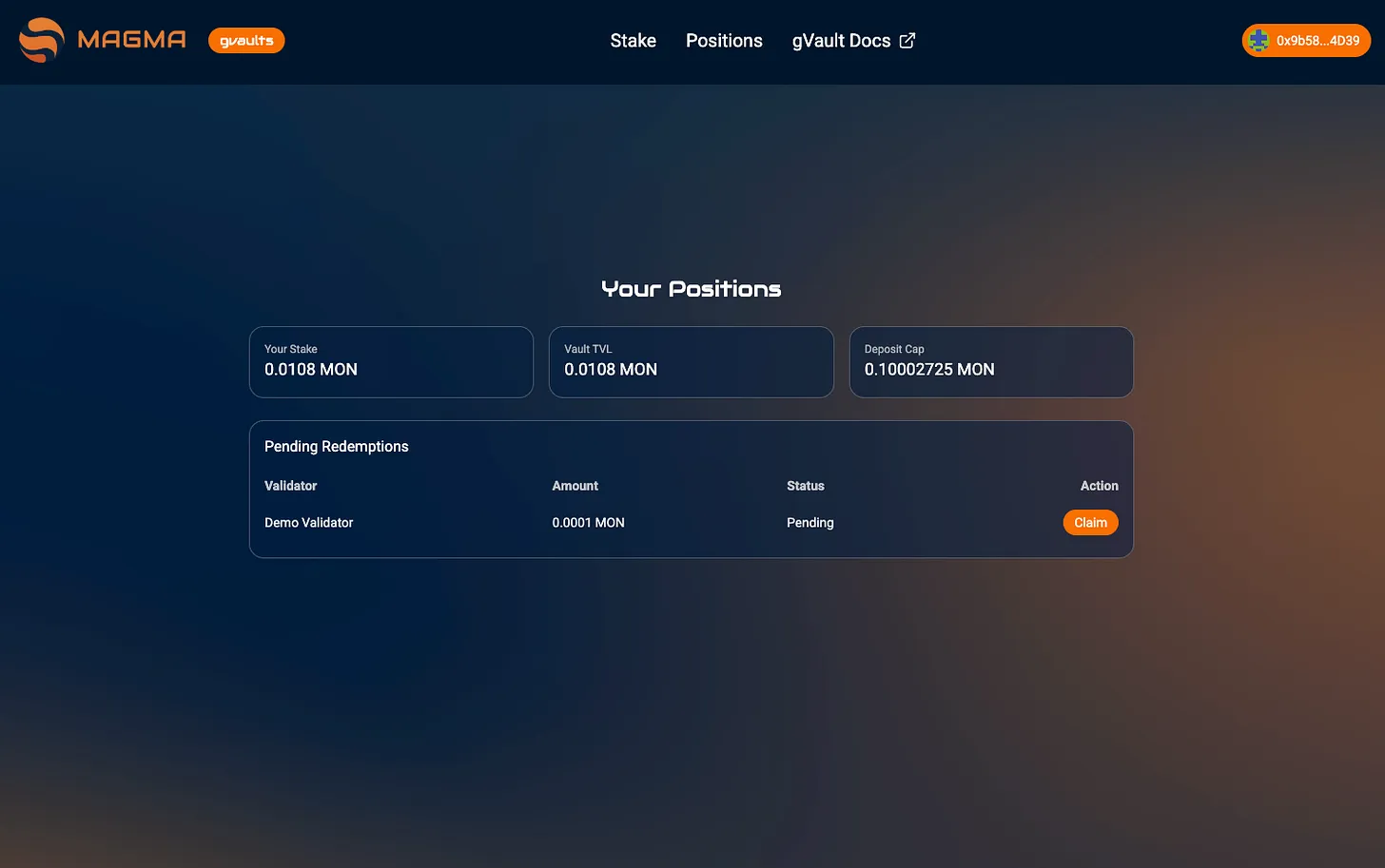
It is also worth noting that, although gMON is a liquid asset, that does not mean exiting staking is instantaneous. Redemption still depends on the logic of the underlying staking on Monad, so withdrawals retain an asynchronous component tied to the unstaking process.
How Magma’s architecture works
One of Magma’s most interesting aspects is its architecture, since it does not simply pool deposits and issue a token. The protocol distinguishes between a pooled staking layer and a layer focused on validator-specific exposure.
CoreVault: the pooled staking engine
The CoreVault is Magma’s pooled staking layer. It receives deposits, distributes them across validators in the active set, coordinates the withdrawals required to process redemptions, and executes rebalances to maintain an even allocation.
In practice, if you enter through this route, you do not need to manually decide how to distribute your stake among validators. The protocol handles it for you.
gVaults: validator-specific exposure without fragmenting liquidity
gVaults are the layer that most clearly sets Magma apart. They allow users to gain exposure to a specific validator without needing to create a different LST for each operator.
Instead of fragmenting liquidity across multiple tokens, Magma keeps gMON as a DeFi-usable asset while also introducing a more specific validator delegation structure. That balance between liquidity and validator choice is one of the most interesting parts of its design.
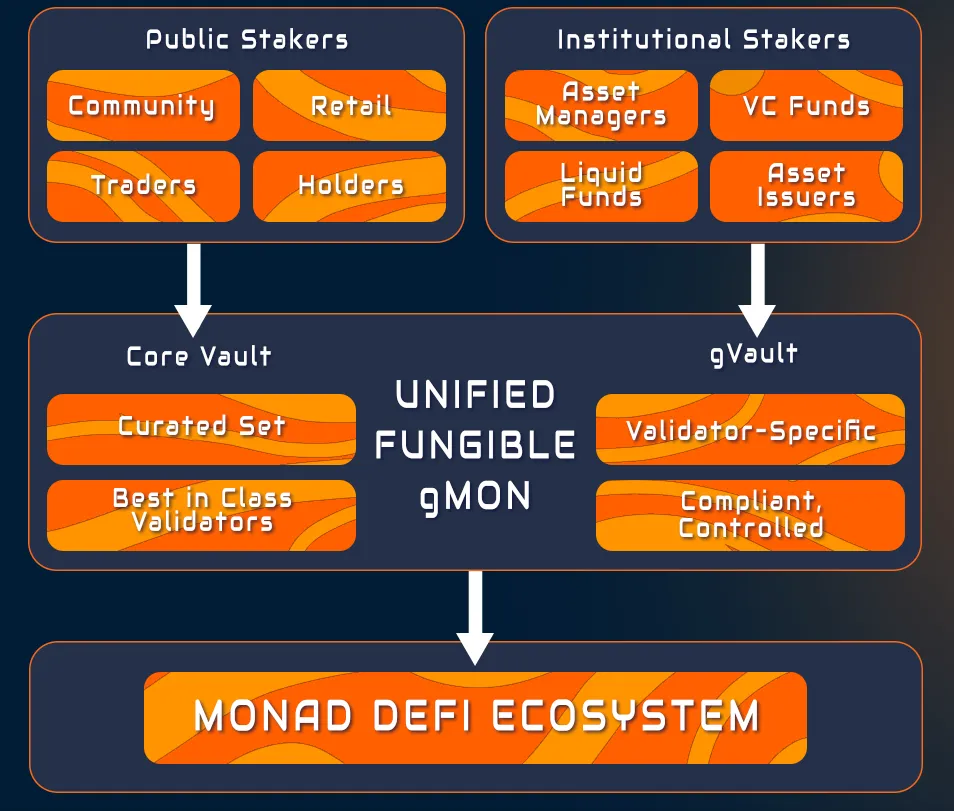
How deposits, rewards, and withdrawals work in Magma
For deposits, Magma allows users to enter with MON or WMON. In the case of the CoreVault, the funds are distributed across validators in the active set. In the case of gVaults, the deposit is associated with the chosen validator within the protocol’s architecture.
For rewards, gMON maintains its non-rebasing logic: your balance does not increase, but the value per unit does. In CoreVault, Magma handles reward claiming, applies fees, and compounds the stake. In gVaults, that accounting is tracked per validator, allowing for more precise exposure.
For withdrawals, the process remains asynchronous. First, you request redemption, and the capital is released once the unstaking period has matured according to Monad’s mechanics.
Join Stakely’s gVault
With the launch of gVaults, at Stakely we joined from day one with our own gVault on Magma. This means you can now liquid stake on Monad with direct exposure to Stakely as a validator.
Key benefits:
- Flexible staking: participate in Monad staking without fully locking up your position.
- Receive gMON to use in DeFi: you can use gMON in strategies such as lending, liquidity provision, and other use cases within the ecosystem.
- Direct delegation to Stakely: your delegation is associated with our validator within Magma’s architecture.
You can now join Stakely’s gVault on Magma and start liquid staking on Monad.