





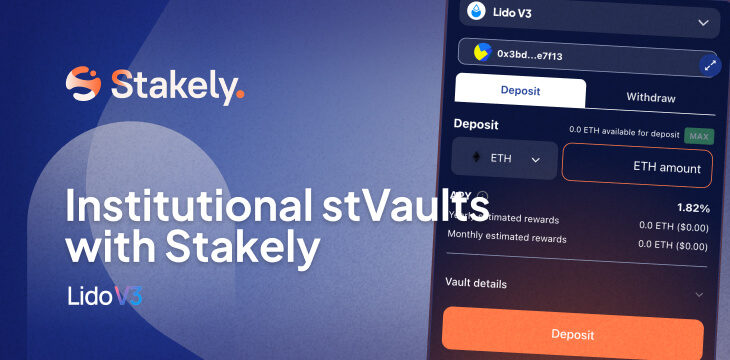
Institutional stVaults on Lido V3: tailored ETH staking for institutions
For an institution, ETH staking is rarely a matter of pressing a button.
A position can involve custody requirements, internal controls, reporting, risk policies, counterparty selection, and liquidity needs. The challenge is that conventional staking models do not always allow all of these elements to be addressed together.
Native staking provides a high level of control over validators, but it requires infrastructure management and is subject to Ethereum's withdrawal timelines. Shared liquid staking products can make liquidity easier to access, but they do not always offer the same degree of control over the operator, configuration, or structure of the position.
Private stVaults on Lido V3 introduce a third option: designing a dedicated staking environment with validators operated by a chosen counterparty and parameters defined for each organisation.
At Stakely, we work with institutions looking to deploy this kind of vault on top of our validator infrastructure.
A vault designed for a specific position
A private stVault allows an ETH position to be separated from other participants and structured around a client's own requirements.
The institution can work with a selected validator operator, such as Stakely, and define how the vault should be configured: fee arrangements, operating permissions, liquidity design, and the technical conditions relevant to its operating model.
This is not about adding complexity for its own sake. It is about making the staking structure reflect how the organisation actually operates.
For some teams, the priority will be a segregated position and a clear view of its activity. For others, it will be optional liquidity through stETH. For others still, the need may be to define a specific infrastructure configuration or build a broader ETH strategy around the vault.
Choose the operator without giving up flexibility
Validator infrastructure no longer has to be an indistinguishable layer.
With a private stVault, ETH can be allocated to validators operated by the counterparty selected by the client. This maintains a direct relationship between the position, the operator, and the infrastructure supporting it.
At Stakely, we handle the technical operation of the validators: monitoring, maintenance, network upgrades, and controls designed to support infrastructure availability. The vault itself can organise roles and permissions to fit each institution's internal processes.
This separation matters. A client does not need to give up its own controls in order to outsource the technical operation of validators.
Liquidity as an architectural decision
One of the most relevant aspects of Lido V3 is that it can incorporate optional liquidity through stETH into a vault's configuration.
This does not require the use of stETH, nor does it turn every position into a liquid staking product. It lets an institution consider liquidity as part of the position's design, rather than treating it as a fixed consequence of the model it chooses.
Depending on the use case, a vault can focus solely on ETH staking or include liquidity mechanisms and additional strategies built on stETH. The appropriate configuration will depend on each organisation's risk policy, treasury needs, custody model, and operating objectives.
Traceability for clearer operations
An institutional position needs to be explainable.
Private stVaults can associate an organisation's assets with a specific vault, operator, and set of parameters. This structure helps provide a clearer view of how the position is configured and which infrastructure participates in it.
It does not replace regulatory obligations or an institution's internal processes. It does provide a more suitable technical basis for assessing them: a separate position, a defined configuration, and verifiable on-chain activity.
This is why stVaults can be relevant for asset managers, treasuries, platforms, custodians, and ETF or ETP issuers that are not simply looking to stake ETH, but to build an ETH operation they can analyse and govern with greater precision.
Stakely's security layer
Vault configuration matters, but so does the party operating the validators.
At Stakely, we have operated nodes and validators since 2020. Our infrastructure combines a distributed architecture, continuous monitoring, and access controls designed to reduce operational risks.
We hold an ISO/IEC 27001:2022 certification and a SOC 2 Type II report, as well as a staking insurance programme subject to its applicable terms. Learn more in our article on how Stakely protects delegated assets.
The model is non-custodial: Stakely operates infrastructure but does not act as custodian of an institution's assets. The custody setup, permissions, and controls are defined for each deployment.
Design an stVault with Stakely
An institutional stVault should not start with a fixed feature list. It should start with the questions that actually determine the operation:
- How is the ETH held in custody?
- What degree of position segregation is required?
- Which controls must apply before operations are executed?
- What role should liquidity play?
- Which infrastructure and fee parameters fit the client's mandate?
From there, Stakely can assess a tailored ETH staking configuration on Lido V3, with our validators as the infrastructure layer.
If your organisation is considering a private stVault, contact our team to explore a deployment aligned with your operating model.