









Discover Lido V3, the modular institutional staking solution on Ethereum with stVaults

Lido V3 introduces a modular staking architecture for Ethereum based on stVaults, enabling the creation of staking products configurable by user profile, risk level, liquidity needs, and yield strategy.
This approach represents an evolution from traditional liquid staking by separating staking logic into independent vaults with their own rules.
In this article, we explain what Lido V3 is, how stVaults work and what types of products can be built using this architecture. If you want to see a practical example of this architecture in action, you can explore Stakely’s DeFi stVault.
What is Lido V3?
Lido has played a key role in the adoption of Ethereum staking, offering liquid staking solutions and ETH yield products.
With Lido V3, the protocol introduces a structural change: stVaults. This architecture enables independent and configurable staking strategies, instead of relying on a shared logic across operators and users. This approach lays the foundation for a more flexible and specialized staking ecosystem aligned with different use cases.
What are stVaults in Lido V3?
An stVault is an isolated staking strategy that defines how a position is managed within Lido V3.
Through an stVault, it is possible to configure elements such as:
- the operator receiving delegated ETH
- the delegation model, either individual or pooled across multiple users
- the fee structure
- stETH minting rules, including whether minting is enabled and the applicable limits (reserve ratio)
- the yield generation strategy in DeFi and its risk profile
Depending on its configuration, an stVault may allow stETH minting within defined limits, or accumulate yield directly inside the vault without exposing a liquid token to the end user.
All of this logic is defined within the stVault itself, enabling differentiated staking products with their own rules and a much more granular control model than traditional liquid staking.
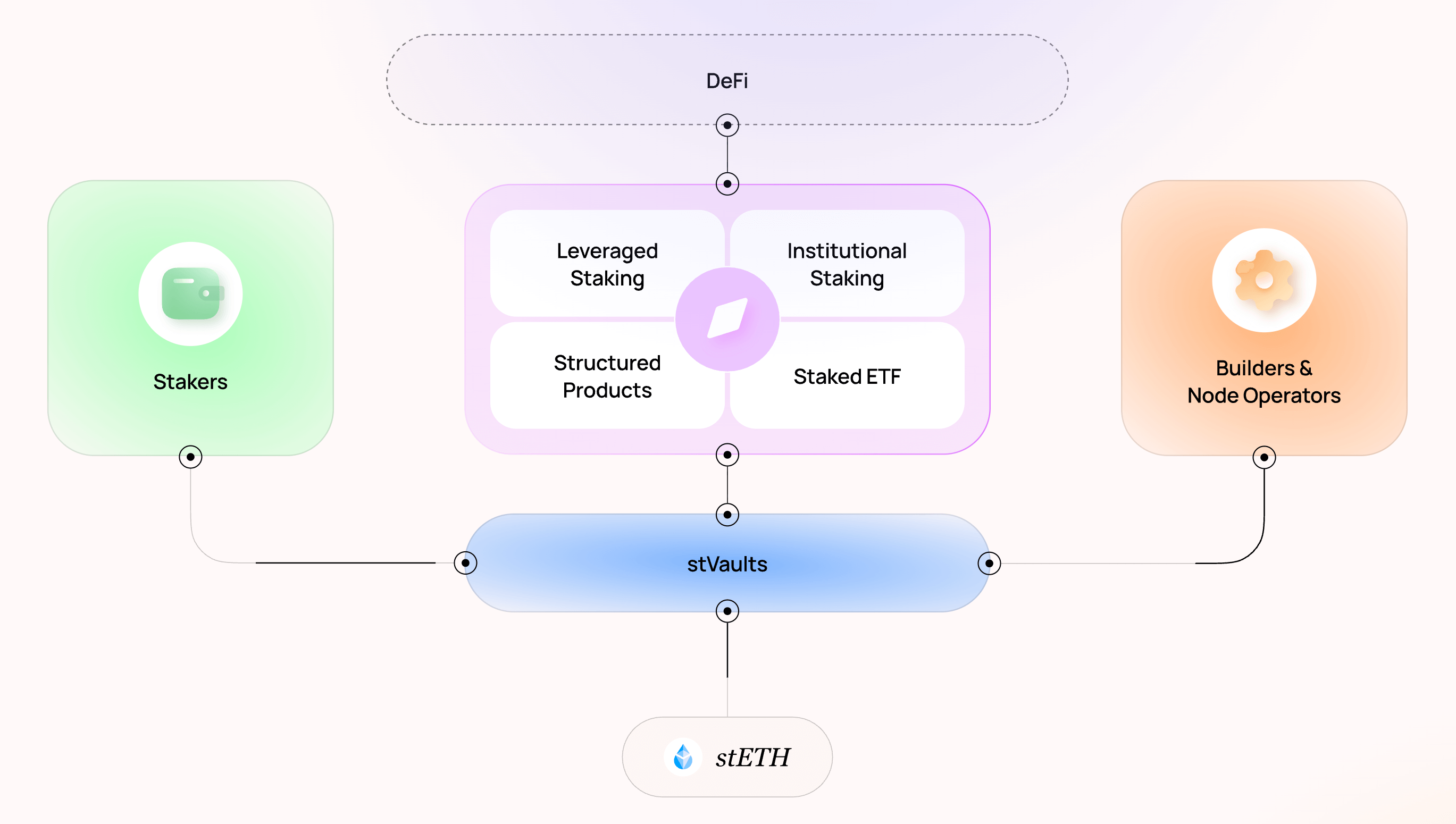
Modular architecture and risk isolation
From an architectural perspective, Lido V3 introduces a modular model in which staking logic is decoupled from the protocol’s core system. Each stVault operates as a self-contained component with its own parameters and responsibilities.
This design enables more specialized staking products while maintaining the protocol’s principles of security, transparency, and decentralization.
Conclusion
Lido V3 turns Ethereum staking into modular infrastructure on which specialized staking products can be built for different types of users.
stVaults enable staking strategies with different liquidity, risk, and yield profiles, expanding the design space of ETH staking beyond the traditional model.
One example of this approach is Stakely’s DeFi stVault, which combines ETH staking with an integrated DeFi strategy. You can learn how it works and start depositing ETH!


